
Criminal Court Records in Livingston County
A criminal court record is the case file the court opens the moment a charge is filed against a defendant. It grows as the case moves, one docket entry at a time. The file holds the charging papers, the bond decision, each plea, the motions lawyers file, the orders a judge signs, and the final judgment of sentence. In Livingston County the file is kept by the clerk for the court that hears the case, and the public docket, called a register of actions, lists every step in date order.
Two local trial courts produce these records. The 53rd District Court handles misdemeanors and the first felony steps, including arraignment on the complaint and the preliminary examination. Felony cases move to the 44th Circuit Court after bindover, where the plea, trial, and sentencing happen. Misdemeanors, punishable by up to one year in jail, usually stay in the District Court. Felonies carry more than a year and route to the Circuit Court once the District Court finds enough evidence. The charge record itself is covered in more depth on the Livingston County arrest records and charges page.
How to Search Livingston County Criminal Court Records
The main tool is MiCOURT Case Search, the statewide portal that covers Livingston County Circuit, District, and Probate cases. It returns the register of actions at no cost, but it does not post document images. Under Michigan Court Rule 8.119, courts cannot publish public document images online, so the actual pleadings, orders, and certified copies still come from the clerk counter or a mail request.
- Open MiCOURT Case Search and choose the court or a person search.
- Search by defendant name, or enter the case number if you already have it.
- Narrow the results with the criminal case-type category, the case year, and a date range.
- Open the case to read the register of actions, the charges, and the disposition.
- Request a certified copy from the clerk when you need a document that holds up in another proceeding.
For a statewide picture, the Michigan State Police run ICHAT, the Internet Criminal History Access Tool, which reports convictions and some pending charges across the state. The Michigan Department of Corrections OTIS system tracks people in prison, on parole, or on probation. Both sit next to the court file rather than replacing it, and neither returns the full docket the clerk keeps.
Certified and plain copies carry set fees. The certification fee is governed by MCL 600.2546, which controls copy and exemplification charges unless another law says otherwise.
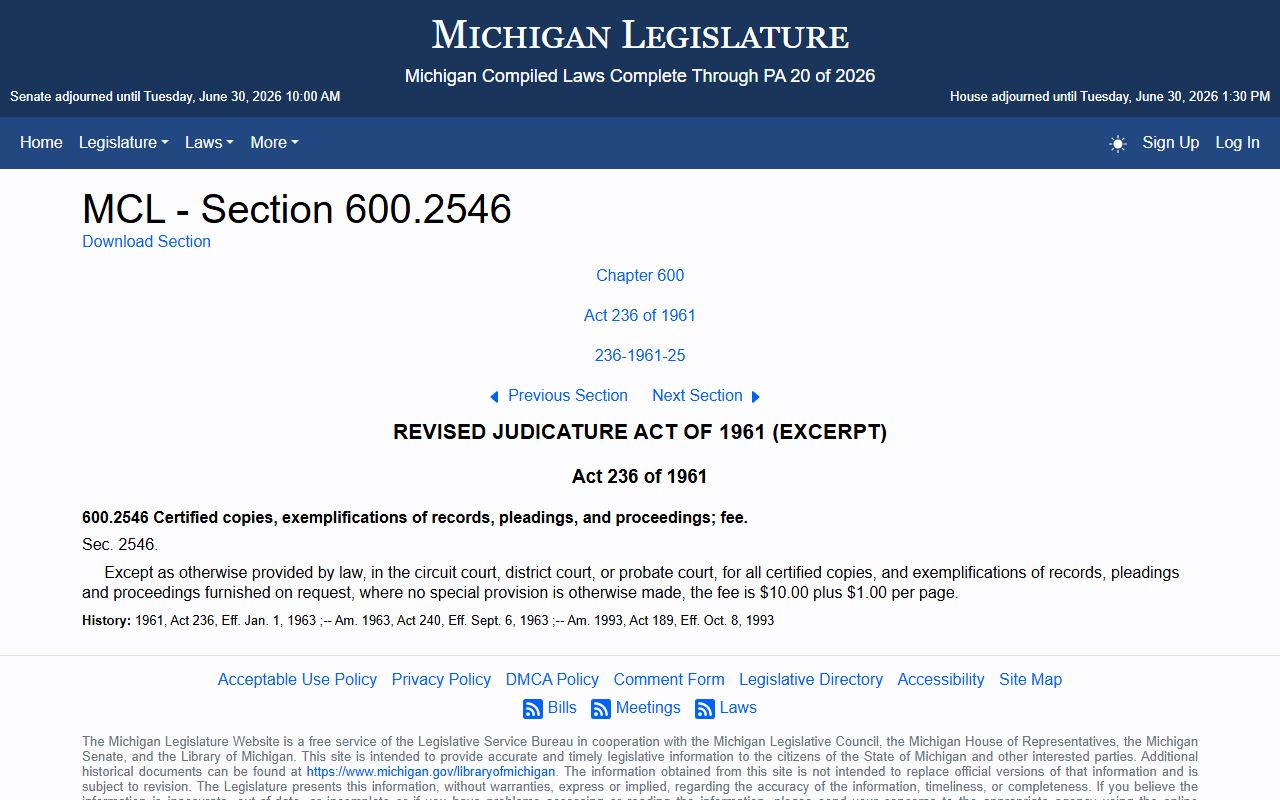
The Circuit Court charges $1.50 per page for a plain copy and $10 per document for certification, and the record copy request form is mailed in with the fee and a self-addressed stamped envelope. A plain printout from the portal is fine for reading a case; a certified copy is the version another court or agency will accept.
Stages of a Livingston County Criminal Case
A criminal case moves through set stages, and each one leaves a mark in the record. Following the stages is the simplest way to read a docket, because the entries line up with the steps below. In Michigan, adult felonies begin in the District Court and finish in the Circuit Court, so a single case can span two court files that share a control tracking number.
Case flow: Charges Filed › Arraignment › Preliminary Examination › Bindover › Circuit Plea or Trial › Disposition › Sentencing
The 53rd District Court holds the early steps for a felony, including arraignment on the complaint and the preliminary examination, where a judge decides whether there is probable cause. If the evidence is enough, the case is bound over to the 44th Circuit Court, which then handles the plea, any trial, and the sentence. A misdemeanor runs its whole course in the District Court. The table below maps the main stages to what the record shows at each point.
| Stage | What Happens |
|---|---|
| Arraignment | The defendant is told the charge and rights, a plea is entered, and bond is set in the District Court. |
| Preliminary Exam / Motions | A District Court judge weighs probable cause on a felony; lawyers file and argue pretrial motions. |
| Plea or Trial | The case resolves by a guilty or no-contest plea, or by a bench or jury trial in the Circuit Court after bindover. |
| Sentencing | After a conviction, the judge enters a judgment of sentence with jail, prison, probation, fines, costs, or restitution. |
What a Livingston County Criminal Court Record Shows
A criminal case file carries a wide set of fields. Some identify the case and the people in it. Others track the charges, the money, and the outcome. Michigan case numbers usually build in the filing year and a case-type code, so a number can hint at the court and the kind of matter before you even open it. The register of actions then lists filings and events in order, from the complaint to the final order.
| Field | What It Shows |
|---|---|
| Case Number | The year and case-type coding that identify the file and the court that holds it. |
| Defendant | The person charged, listed as the party the prosecutor is proceeding against. |
| Charges | Each charge with its statute or ordinance, offense date, and classification. |
| Plea | The formal answer to each charge, such as guilty, not guilty, or no contest. |
| Disposition | How each charge ended: convicted, dismissed, acquitted, or deferred. |
| Sentence | The judgment imposed, including jail or prison time, probation, fines, costs, and restitution. |
Alongside these, the file records the assigned judge or magistrate, the attorneys of record, hearing dates and courtrooms, bond amounts, and payment status on fines and costs. Document images stay off the internet under MCR 8.119(H), so the online view shows activity while the paper or certified document waits at the clerk counter. For a broader look at every court record type the county keeps, the Livingston County court records page covers civil, family, and probate files as well.
Charges vs. Convictions
Being charged is not the same as being convicted. A criminal court record can list a charge that was later dropped, dismissed, or ended in an acquittal. A charge is only an accusation, filed on probable cause. A conviction is a finding of guilt, reached by a plea or a verdict under a much higher standard. Both appear in the public file, so reading the disposition beside each charge matters as much as reading the charge itself.
| Charge | Conviction | |
|---|---|---|
| Stage | Accusation | Verdict or plea |
| Burden of Proof | Probable cause | Beyond a reasonable doubt |
| Public Record | Yes | Yes |
Reading Livingston County Dispositions and Sentences
The disposition is the outcome line, and it is where most people look first. Common entries include guilty, not guilty, dismissed, no contest, and deferred. A guilty or no-contest plea leads to a judgment of sentence. A dismissal closes a charge without a finding of guilt. A deferred outcome holds the case open while the defendant meets set conditions, and it can end in a dismissal if those conditions are kept.
The sentence appears as its own set of entries. It may combine jail or prison time, probation with terms, fines and court costs, and restitution ordered paid to a victim. A probation review or a show-cause entry later in the docket signals that the court is checking compliance. Reading the disposition and the sentence together gives the true shape of the case, since one charge can be dismissed while another in the same file ends in a conviction and a sentence.
Note: A single case file can hold several charges, and each charge carries its own plea, disposition, and sentence, so read every line rather than the top charge alone.
Prosecutor, Discovery, and the Public Defender
The Livingston County Prosecuting Attorney brings criminal charges after a police investigation and carries them through the case. Carolyn Henry serves as Prosecutor and is the county's chief criminal law enforcement officer, an elected post separate from the state Attorney General. The office also runs the discovery process, where charging papers, reports, and evidence are shared with the defense. A defense attorney files an appearance and a demand for discovery, while a defendant can request a report by email with the case number and name.
People who are not a party to the case take a different path. They file a Freedom of Information Act request with the police agency and include the case or complaint number, the defendant's name, and what they need. Court files, though, are not FOIA records, because Michigan's FOIA excludes the judiciary. That is why the case docket comes from MiCOURT or the clerk, while a police report comes from the department that wrote it.
Defendants who cannot afford a lawyer may qualify for the Livingston County Office of the Public Defender, a full-time office led by Chief Public Defender Karen Groenhout. The defenders are county employees who work only for their clients, and their appearances and filings show up in the case record like any other attorney of record.
Livingston County Prosecuting Attorney
Law Center, 210 S. Highlander Way
Howell, MI 48843
(517) 546-1850
milivcounty.gov/prosecutor
Sealed vs. Set Aside in Livingston County
Michigan uses two different tools to limit access to a criminal record, and they are easy to confuse. Sealing hides a case from public view by court order under MCR 8.119(I), though court orders and opinions in the case stay public and cannot be sealed. Setting aside is Michigan's word for expungement. It does not destroy the record; it makes an eligible conviction nonpublic while the state keeps a private copy for limited legal uses.
The rules that keep a set-aside record nonpublic are spelled out in the Michigan Compiled Laws. The statute below explains the nonpublic file the state retains after an order is granted.
You can read the retained-record rule at MCL 780.623, which treats a set-aside conviction as nonpublic while allowing narrow statutory access. The comparison below lines up the two tools side by side.
| Sealed | Set Aside | |
|---|---|---|
| Visibility | Hidden from public by court order | Conviction made nonpublic under MCL 780.623 |
| Law Enforcement | Limited access; orders stay public | State keeps a nonpublic record for statutory uses |
| Eligibility | Written motion, good cause, no less restrictive means | Set-aside statute under MCL 780.621, or automatic Clean Slate |
Setting Aside a Conviction in Michigan
Michigan's set-aside statutes begin at MCL 780.621 and following. For an eligible conviction, a person applies in the court where the conviction happened using SCAO form MC 227, unless the state clears it automatically under Clean Slate. Clean Slate sets timing by offense: eligible felonies after ten years, and eligible misdemeanors of 93 days or more after seven years. The automatic path caps out at two felonies and four serious misdemeanors.
Traffic offenses carry a special caveat that surprises many applicants, and the statute below lays it out.
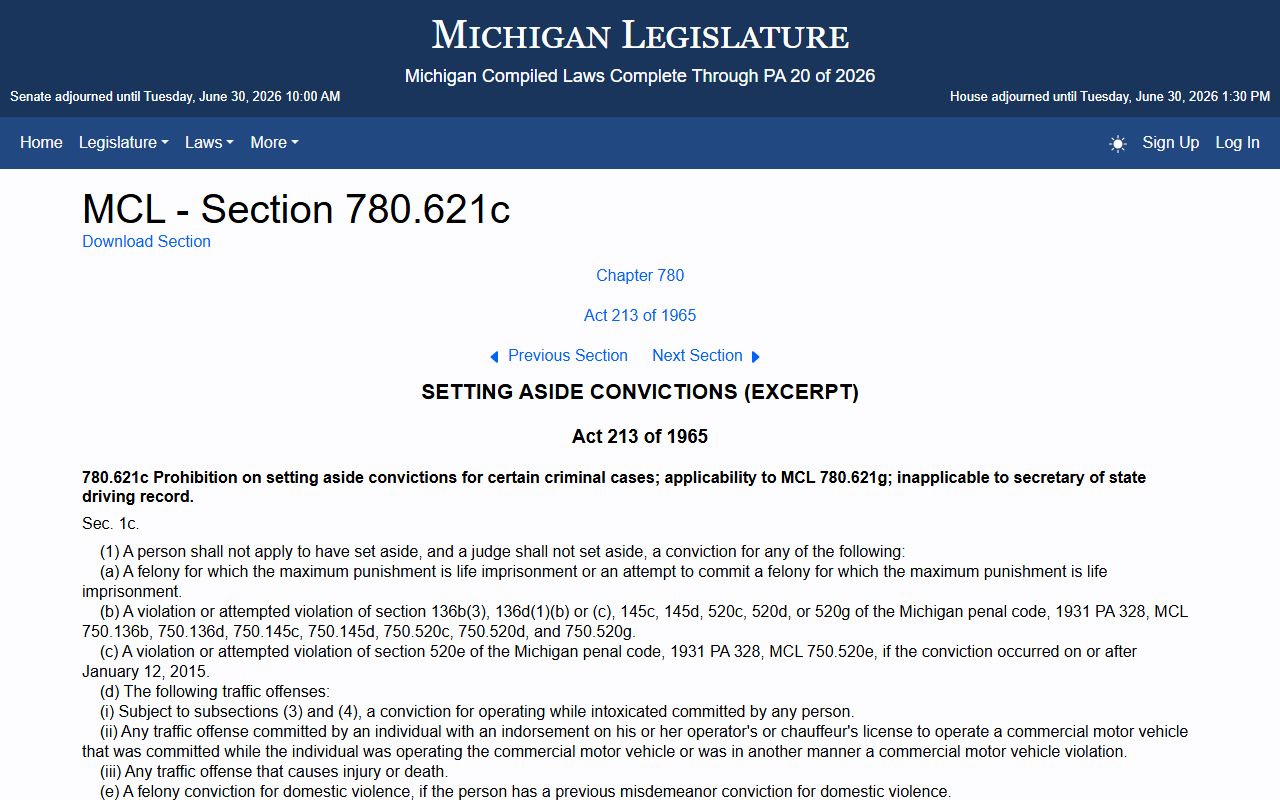
Under MCL 780.621c(5), setting aside a traffic offense does not force the Secretary of State to remove it from the driving record. A conviction can be nonpublic in the court file yet still appear on the state driver record, so a set-aside order and a clean driving record are not the same thing.
Public Access to Livingston County Criminal Court Records
Criminal case files are open to the public, but they travel through court rules rather than the state FOIA. Michigan's FOIA excludes the judiciary, so a court file is reached through MiCOURT and the clerk counter, not a FOIA request. Court Rule 8.119 supports public inspection of case records while limiting online document images, which is why a docket can be viewed online yet a certified pleading still requires the clerk. ICHAT reports statewide criminal history but leaves out warrants, traffic, and juvenile matters, so it complements the court file rather than replacing it.
Key Statutes:
MCR 8.119 - The main Michigan court-record rule; it opens case records to public inspection while limiting online document images.
MCL 15.231 to 15.246 - The Michigan FOIA; it reaches county agency records but excludes the judiciary, so court files fall outside it.
Background Check Considerations
A criminal case lookup for personal reasons is not the same as a regulated background check. Employment, tenant, and credit screening fall under the federal Fair Credit Reporting Act, which sets rules on accuracy, notice, and consent. A casual read of a public docket carries none of those protections and none of that legal weight, so it should never stand in for a compliant, FCRA-covered report.
Important: This website is not a consumer reporting agency under the FCRA, and its information may not be used for employment, tenant, credit, or other FCRA-regulated screening.
Restricted Criminal Court Records in Livingston County
Not every criminal-related file is open. Some are sealed by court order, some are nonpublic by statute, and some are held in separate locked files. Adoption files are nonpublic under MCL 710.68 and are kept apart, open only by court order for good cause or specific statutory access. Mental-health proceedings, which can surface in criminal and specialty-court contexts, are protected by the Michigan Mental Health Code.
The confidentiality rule for mental-health information is set by MCL 330.1748, which keeps recipient records and service information private except where the law allows release. Certain physician and mental-health professional reports also stay out of the public court file under the SCAO nonpublic records chart.
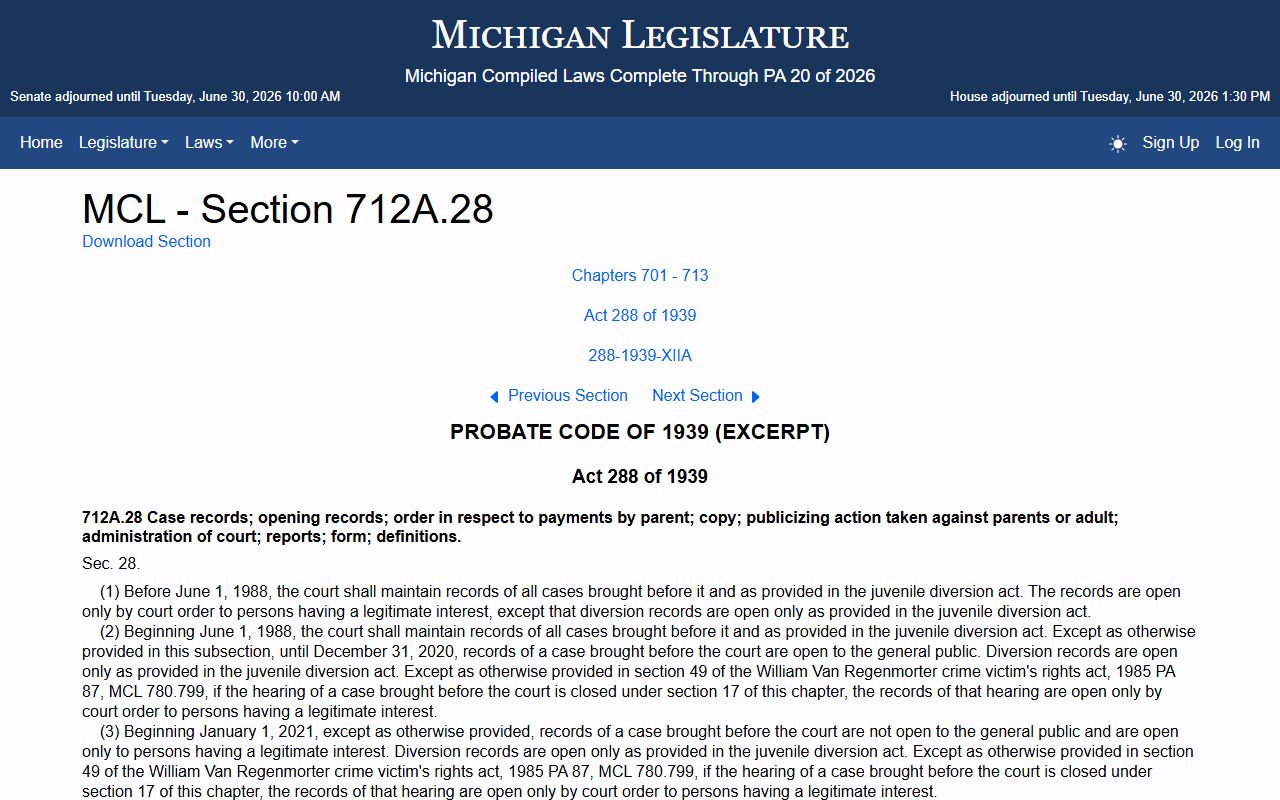
Juvenile case records get their own protection under MCL 712A.28, which governs who may see a juvenile file. Diversion and consent-calendar records are held even tighter, and access is usually limited to the parties, their attorneys, and agencies with a recognized interest.
Livingston County Juvenile Records and Adjudications
Juvenile matters are not handled like adult criminal cases. In Livingston County, delinquency cases involving young people generally route through the Circuit Court Family Division rather than the ordinary District Court criminal docket. A juvenile is found responsible through an adjudication, not a conviction, and the record stays largely nonpublic to protect the young person's future.
Michigan also lets certain juvenile adjudications be set aside, and the statute below covers that process.
The juvenile adjudication set-aside rule sits at MCL 712A.18e, which spells out when an eligible adjudication can be made nonpublic. If you need to know whether someone is currently in custody, the Livingston County inmate records page covers the jail roster and booking side, while active warrants appear on the Livingston County warrant records page.