
Livingston County Circuit Court Overview
The 44th Circuit Court is the county's court of general jurisdiction. Michigan uses a three-part trial court system, and the Circuit Court sits at the top of that group for the most serious and highest-value matters. It hears felony cases after they are transferred up from the District Court, civil claims that rise above the District Court money limit, and equitable relief the lower court cannot grant. It also runs a Family Division for divorce, custody, support, and juvenile cases, and it handles personal protection orders, extreme risk protection orders, and legal name changes.
The court's authority comes from state law. Under MCL 600.605, circuit courts have original jurisdiction over all civil claims and remedies except where a statute gives another court exclusive power. That broad grant is what makes the 44th Circuit Court the default venue for cases too large or too serious for the local district and probate courts. In Livingston County the court also takes appeals from the District Court and Probate Court where the law allows, which places it between those courts and the state appellate system.
Michigan groups its trial courts on a statewide map, and Livingston County carries the identifiers C44 for the Circuit Court, D53 for the District Court, and P47 for the Probate Court. The state judiciary's trial-court structure pages explain how these three court types divide the work across every county.
The image below shows how the Michigan Courts site lays out that trial-court framework for the public.
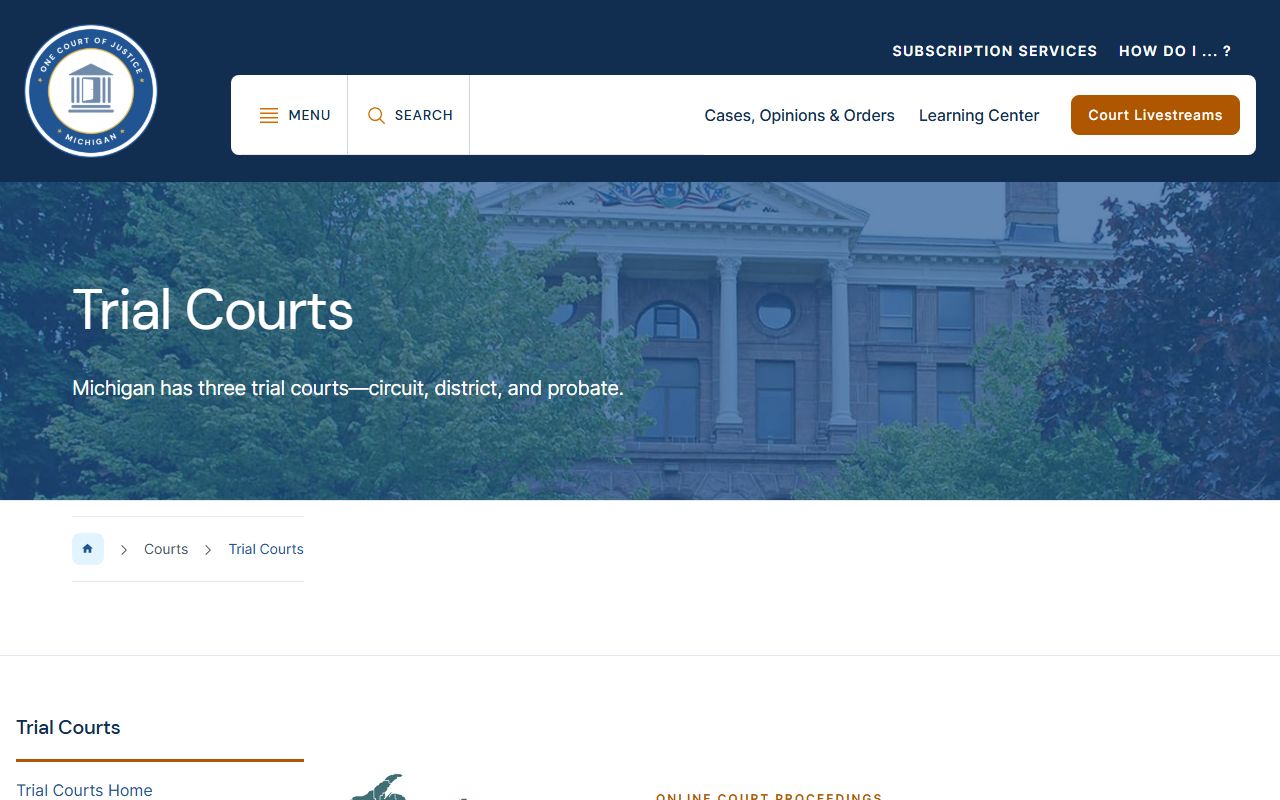
Reading the state map first helps confirm whether a Livingston County record belongs to the Circuit Court or to one of the two other trial courts.
Livingston County Courts and Offices
Most Circuit Court business runs through the Judicial Center on South Highlander Way in Howell, where the District Court, Probate Court, and Circuit Court Clerk all keep counters. The County Clerk's vital-records and civil-filing counter sits at the Historic Courthouse downtown, and the Prosecutor works from the nearby Law Center. The table lists the offices a Circuit Court case can touch, along with the address, phone, and the role each one plays.
| Court / Office | Address | Phone | Role |
|---|---|---|---|
| 44th Circuit Court | 204 S. Highlander Way, Howell, MI 48843 | (517) 546-3060 | General trial court; felony after bindover, higher civil, family and domestic, appeals, PPO, name change, specialty courts. |
| Circuit Court Clerk | 204 S. Highlander Way, Suite 4, Howell, MI 48843 | (517) 546-9816 | Circuit filings, records, copies, motion schedule, transcripts, payments. |
| 53rd District Court | 204 S. Highlander Way, Suite 1, Howell, MI 48843 | (517) 548-1000 | Misdemeanors, initial felony steps, traffic and civil infractions, landlord-tenant, small claims, civil up to $25,000, warrants. |
| Probate Court | 204 S. Highlander Way, Suite 2, Howell, MI 48843 | (517) 546-3750 | Estates, trusts, guardianships, conservatorships, mental health, probate filings and copies. |
| County Clerk | 200 E. Grand River Ave., Howell, MI 48843 | (517) 546-0500 | Vital records, marriage, elections, assumed names, record keeping; the elected clerk is also Circuit Clerk. |
| Prosecutor | 210 S. Highlander Way, Howell, MI 48843 | (517) 546-1850 | Criminal prosecution, victim rights, family support, discovery and report requests. |
Court counters keep regular hours of 8:00 a.m. to 5:00 p.m., Monday through Friday, while the County Clerk downtown closes at 4:30 p.m. Callers should match the office to the record: a felony judgment lives with the Circuit Court Clerk, a small-claims file with the District Court, and a marriage certificate with the County Clerk.
How a Case Moves Through the Livingston County Courts
A felony does not start in the Circuit Court. The 53rd District Court handles the opening steps, including arraignment on the complaint and the preliminary examination. If the District Court judge finds enough evidence, the case is bound over, meaning it is transferred up to the 44th Circuit Court. The Circuit Court then carries the case through pleas, motions, trial, and sentencing, and it keeps jurisdiction over post-judgment matters. Misdemeanors and traffic misdemeanors stay in the District Court unless a specific law routes them elsewhere.
Felony path: Arrest › District Court Arraignment › Preliminary Examination › Bindover › Circuit Court Arraignment › Pretrial › Plea or Trial › Sentencing › Appeal
Civil path: Complaint Filed › Answer › Discovery › Motions › Mediation or Settlement › Trial › Judgment › Appeal
Civil disputes reach the Circuit Court directly when the amount in controversy passes the District Court ceiling or when a party seeks relief only a general-jurisdiction court can order. A few terms come up again and again in this flow, so short definitions help:
- Preliminary examination
- A District Court hearing that decides whether there is probable cause to send a felony to the Circuit Court.
- Bindover
- The transfer of a felony case from the District Court to the Circuit Court after probable cause is found.
- General jurisdiction
- Authority to hear nearly any type of case unless a statute assigns it exclusively to another court.
- Judgment of sentence
- The Circuit Court's final order stating the conviction and the punishment imposed.
Note: Juvenile felony and misdemeanor matters for youth are usually handled in the Circuit Court Family Division rather than as ordinary District Court criminal cases.
Circuit Court vs. District Court vs. Probate Court
Michigan's three trial courts split the work by subject and by dollar value rather than by geography. The Circuit Court takes the largest and most serious cases, the District Court handles local and lower-value matters, and the Probate Court manages estates and protective proceedings. The comparison below lines up the three courts on the points people ask about most.
| Circuit Court | District Court | Probate Court | |
|---|---|---|---|
| Civil limit | Above $25,000; no upper cap | Up to $25,000 | Estate and trust value, no fixed cap |
| Criminal jurisdiction | Felonies after bindover | Misdemeanors and initial felony steps | None |
| Family cases | Yes, through the Family Division | No | Guardianship and mental health only |
| Appeals | Hears appeals from District and Probate | None | None |
| Governing statute | MCL 600.605 | MCL 600.8301 | MCL 700.1302 |
The District Court civil jurisdiction statute caps that court's money cases at $25,000, which is why anything larger opens in the Circuit Court. The Probate Court's power under MCL 700.1302 is exclusive over estate settlement, so those files never appear in the other two courts.
Searching 44th Circuit Court Records
Public case history for the Circuit Court is searchable through MiCOURT, the statewide case-search system that also covers the District and Probate courts. A search returns the register of actions, which is the running list of everything filed and ordered in a case. The county's Circuit Court Records page confirms that 44th Circuit Court registers can be viewed at no cost through the state system. To reach an actual pleading, order, or certified copy, a person still needs the clerk counter or a mail copy request.
The starting point for most searches is the state case-search entry page, which is described at the MiCOURT Case Search portal.
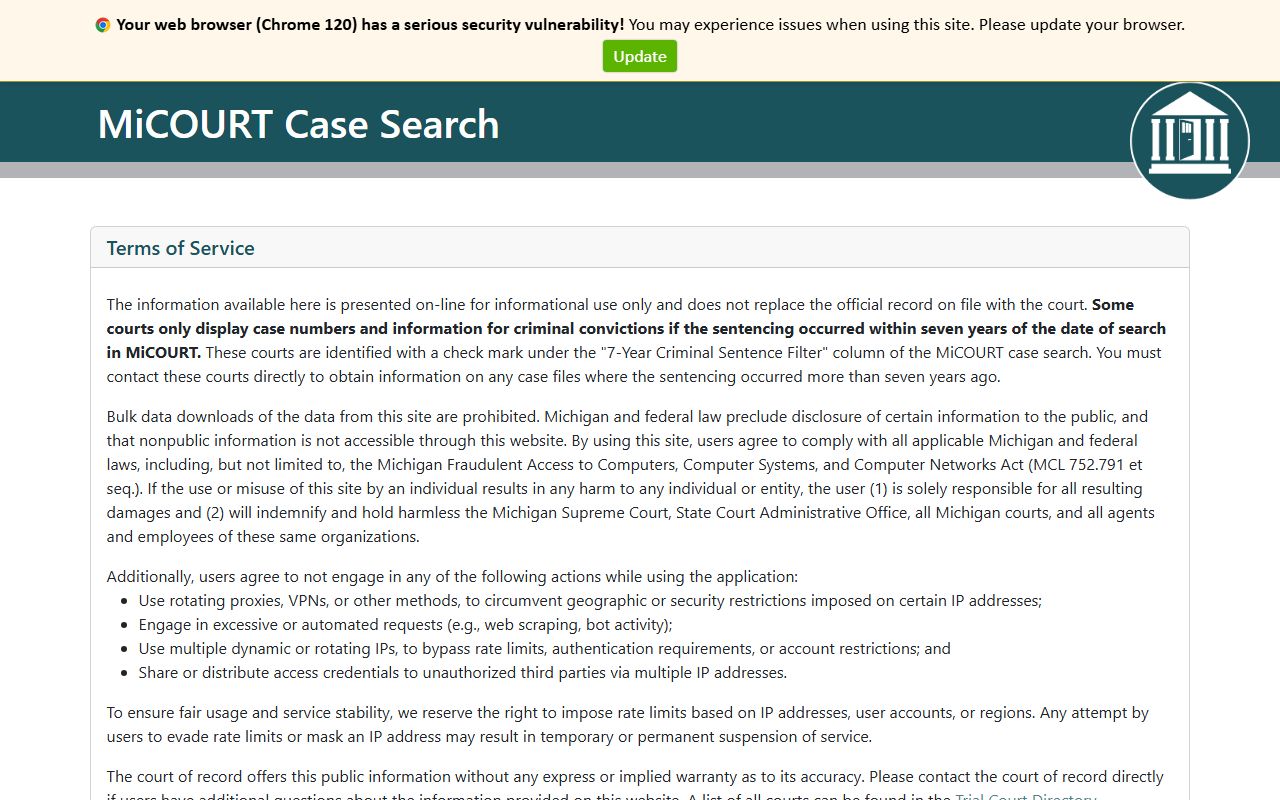
From that page a user can search by case number, party name, case type, category, and year across all three Livingston County trial courts.
A short routine keeps a search on track:
- Decide which court holds the file. Use the Circuit Court for felony files after bindover, higher-value civil cases, divorce and family matters, PPOs, appeals, and name changes.
- Open the MiCOURT case-search page and enter a case number if you have one.
- If not, search by last name and first name, then narrow by case-type category such as civil, criminal, domestic, or appeals.
- Review the register of actions for parties, judge, status, hearings, and docket entries.
- For a certified copy or a full document, contact the Circuit Court Clerk or mail a record copy request with the fee.
The searchable fields and filters are documented for developers on the state's MiCOURT case-search documentation, which lists options for case number, name, case type, status, date of birth, file-date range, disposition date, and more.
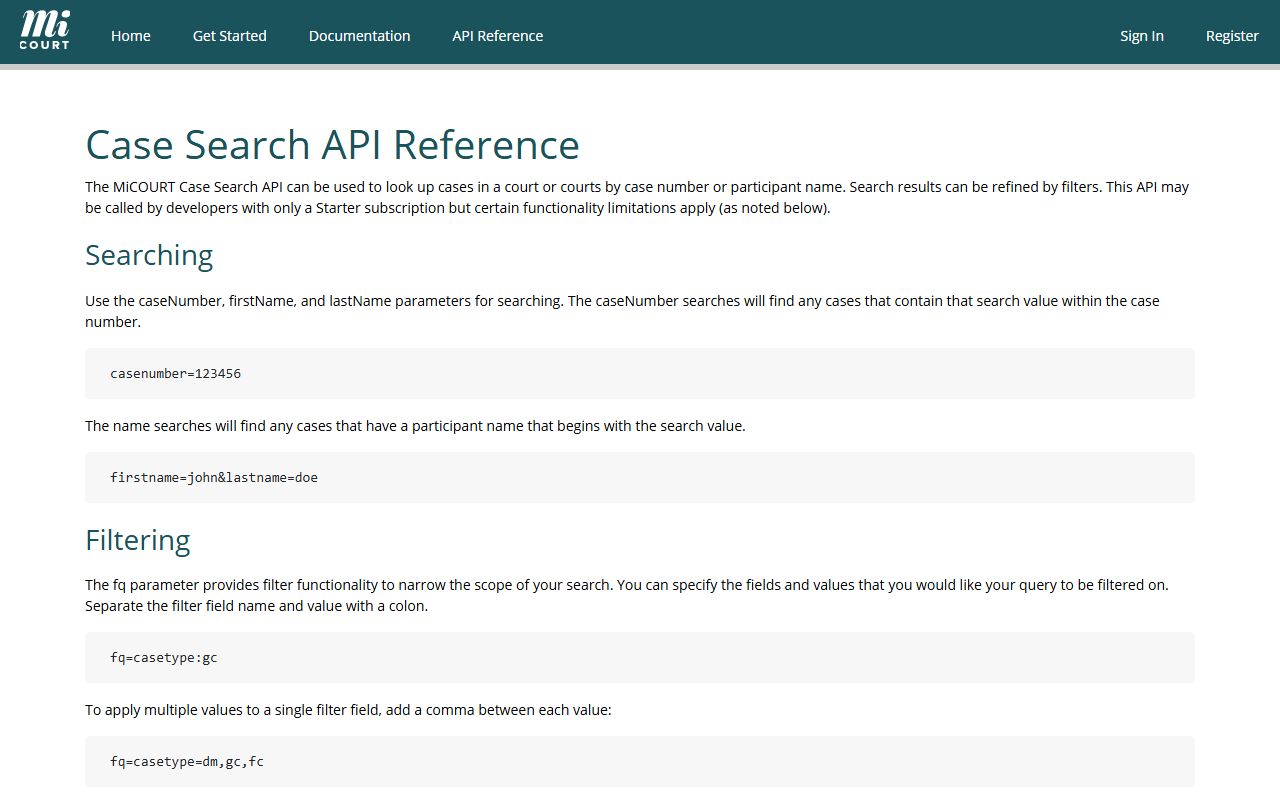
Those field definitions explain why a broad name search can be narrowed down to a single Livingston County case with a birth date or a case-type filter. A deeper walkthrough of every search channel lives on the Livingston County court records page, and scheduled hearings appear on the court dockets page.
Court records are not FOIA records. Michigan's Freedom of Information Act excludes the judiciary, so Circuit Court files travel through court channels, not FOIA. Under MCR 8.119, courts are also barred from posting document images online, which is why the register of actions is public online but the actual pages usually require a counter visit or a written copy request.
The state's records-management guidance spells out that public electronic documents, where they exist, must be accessed at the courthouse rather than over the internet.
That guidance is the reason a Livingston County researcher may see full case activity online yet still need to request the paper file for the ruling itself.
Judges of the Livingston County Circuit Court
Three judges anchor the trial-court bench that serves Livingston County. Each carries a specific set of dockets, and knowing who presides over what helps a record seeker understand how a case was routed. The Circuit and District courts share a Chief Judge, which reflects how closely the felony pipeline links the two levels.
- Hon. Matthew J. McGivney is Chief Judge of the 44th Circuit and 53rd District Courts, selected as Chief Judge in 2024. He presides over the Adult Drug Treatment Court and the Business Court and is lead judge for Swift and Sure Sanctions.
- Hon. Susan Longsworth is the presiding judge of the Family Division, handling large shares of the civil, domestic, appeals, PPO and ERPO, and name-change dockets, and she presides over the Juvenile Drug Treatment Court.
- Hon. L. Suzanne Geddis leads the Intensive Treatment Court and was the first woman to hold a Livingston County 44th Circuit judgeship after being the first woman elected to the 53rd District Court.
Probate Court is led separately by Chief Judge Miriam A. Cavanaugh, while the District Court bench includes Judges Daniel B. Bain and Shauna N. Murphy and Magistrate Jerry D. Sherwood. The 44th Circuit judges are the ones who sign felony judgments, divorce decrees, and protective orders in the county.
Circuit Court Family Division in Livingston County
The Family Division of the 44th Circuit Court handles the domestic side of general jurisdiction. That covers divorce, custody, parenting time, child and spousal support, paternity, and juvenile delinquency and neglect. It also issues personal protection orders and extreme risk protection orders, and it processes legal name changes. Divorce filing requirements differ for cases with and without children, and the paperwork can include a summons, complaint, verified statements, Friend of the Court forms, and a final judgment.
Family cases often connect to vital records the County Clerk keeps, such as marriage and birth certificates. Livingston County runs an online vital-record search and application system for those documents, described on the county vital-record portal.
That system helps a person confirm a marriage record before or after a Family Division divorce case, since the marriage certificate and the divorce file sit with different offices. Marriage and divorce paperwork are covered in more detail through the county's Clerk of the Circuit Court channels for court copies.
Fees give a sense of what a Family Division filing costs. A selection appears below.
| Filing | Fee |
|---|---|
| Divorce without children | $175 |
| Divorce with children | $255 (includes Friend of the Court fee) |
| Name change | $185 |
| Plain copy | $1.50 per page |
| Certified copy | $10 per document |
Sensitive details involving minors and protected personal identifying information may be redacted or limited, so some Family Division entries appear in the register of actions without the underlying document.
Specialty Courts in Livingston County
Beyond its regular dockets, the 44th Circuit Court runs several problem-solving courts that combine supervision with treatment. These programs handle eligible defendants outside the standard track, aiming at rehabilitation rather than a plain sentence. They are court operations, not public record-search tools, but they explain why some Livingston County criminal files show treatment-court hearings and reviews.
- Adult Drug Court accepts non-violent misdemeanor and felony defendants with a diagnosed substance use disorder. Felony matters are presided over by Chief Judge McGivney and misdemeanor matters by Judge Bain, with hearings on the first and third Wednesdays each month.
- Intensive Treatment Mental Health Court serves non-violent defendants with serious mental illness, presided over by Judge Geddis, with hearings on the first three Wednesdays and NAMI on the fourth.
- Veterans Treatment Court is a problem-solving court for justice-involved veterans; the county's 2024 report recorded a high of 17 participants and 8 graduates.
- Juvenile Drug Treatment Court serves youth with substance use disorders in the juvenile justice system and is presided over by Judge Longsworth through the Family Division.
Admission to the adult programs generally starts when a defense attorney submits a referral packet. The county's specialty courts page lists the programs and their eligibility notes, and its 2024 annual report tracked graduation figures and a five-year federal grant supporting the Adult Drug Court.
Note: Detailed eligibility rules for the Veterans Treatment Court were not published in the sources reviewed, so branch-of-service or discharge criteria should be confirmed directly with the court.
Appeals and the Federal Court Distinction
A party unhappy with a 44th Circuit Court decision can seek review at the Michigan Court of Appeals, the state's intermediate appellate court. From there the path can continue to the Michigan Supreme Court, the court of last resort and the administrative head of the state judiciary. The Circuit Court itself also sits in an appellate role for the county, since it hears appeals from the District Court and Probate Court where the law allows. That places the 44th Circuit Court in the middle of the ladder, above the two limited-jurisdiction trial courts and below the appellate bench.
State court appeals should not be confused with federal court. Livingston County falls within the United States District Court for the Eastern District of Michigan, a separate system that hears federal crimes, federal-question civil suits, and diversity cases. Criminal matters from Livingston, Genesee, Lapeer, and Shiawassee counties are assigned to the federal courthouse in Flint. Federal cases are unrelated to a 44th Circuit Court file, and most federal records are reached through PACER rather than the state system.
Because the two systems run on parallel tracks, a complete search sometimes means checking both. A Livingston County resident with a state felony judgment and a separate federal matter would find one file through MiCOURT and the county clerk, and the other through the federal court in Flint.